• Skip to main content
Footnotes VMT
  • EXPLORE
  • PLAN
  • INFO
  • Contact Us
  • My Account
My Account

Articles

Visual and Simultaneous Thinking – aiding memory & communication skills’

Language Learning & Dyslexia Symposium – School of Oriental & African Studies, London
As globalisation marches on, overcoming language barriers has become increasingly important, and the requirement for global translation is rapidly growing.  Linear, lexical information transmission is the norm, and most of us don’t think twice about it.  But the logic behind the structure of language differs dramatically from language to language, and could often be better understood in holistic rather than linear terms; direct translation from words of one language to words of another is often counter-intuitive and ‘illogical’.  

In addition, we train our children to think and learn in words from a very early age, marginalising alternative ways of processing information.  We know that children learn through play, but we hope that they learn to read and write sooner rather than later.  We assume that traditional words-based teaching and training methods are right and proper, and that people who don’t get on with them lack a degree of intelligence.  Our schools and universities are consequently squeezing non-linear thinkers out to the margins, quashing creativity and variety in a bid to produce students who will pass exams.  Many of these marginalised learners are branded with a ‘learning difficulty’ label, simply because they think and learn in a way that is incongruous with traditional classroom teaching.  In truth their difficulty often lies with the teaching methods they are subjected to, rather than their intellects.  Even if a visual thinker is identified, teachers and parents can struggle to know how to encourage this ‘different’ way of thinking, often because they simply don’t understand it.

Learners who think in a holistic, visual way often find written language difficult.  Most of the issues that visual thinkers and dyslexic learners struggle with stem from having to read or write sentences in which letters, words and information must be sequenced.  Professor John Stein of Oxford University has been researching the physiological reasons for dyslexic reading behaviour.  The following is quoted from a seminar he gave (“Visual Dyslexia: Force of Artistic Talent”) at the 2003 Arts & Visual Thinking Conference in Falmouth:

“Reading requires precise sequencing of letters and word sounds, and in fact there is no other normal activity of human beings that requires such precise linear sequencing.  But dyslexics are bad at this kind of sequencing… because they inherit a vulnerability of a particular kind of nerve cell in the brain called a Magna cell… Magna cells play a very important part in reading in particular, because they control how the eyes move during reading.  How the eyes move during reading determines how you sequence things – how you sequence small objects such as letters.”

He has found that due to a developmental deficiency in Magna cell formation in the brain, the eyes of dyslexics do not move from left to right in tiny movements like a ‘normal’ reader’s eyes.  They tend to make larger eye movements, and consequently find it very difficult to sequence letters and words.  There are several ways to improve reading ability; I have found that dyslexics find it easier to read in columns – when working with children I limit the number of words to five per line.  Coloured lenses have proven to be very effective for some dyslexics, and Professor Stein has shown that this is because Magna cells are particularly sensitive to yellow and blue light, and so by wearing coloured lenses the Magna cellular system can be boosted to improve reading.  

But the pressure of having to sequence information linearly can make a dyslexic or visual thinker freeze, and can sometimes stop them from reading, saying or writing anything at all.  Holistic, visual thinkers will sit down at the computer to write an essay, and they might get out a few sentences before they stop because it doesn’t sound right, or they haven’t used the correct grammar, or the spelling needs correcting.  But by the time they’ve gone back over those sentences to try and get them right they have lost about five other thoughts that they had when they were initially inspired to write.  This is not only unproductive but extremely demoralising.  

And it is a pattern that is all too familiar for visual learners.  Whatever the information they are attempting to process (from filling in forms to language learning), sequencing is often their greatest stumbling block.  Visual thinkers see holistically, they see all the information at once, rather than in a linear order.  Written words are therefore like a foreign language to them, even in their mother tongue.  

So is there a way in which visual thinkers can learn more easily?  A way in which they can process information and communicate holistically?  Is there a way to break down language barriers more efficiently?

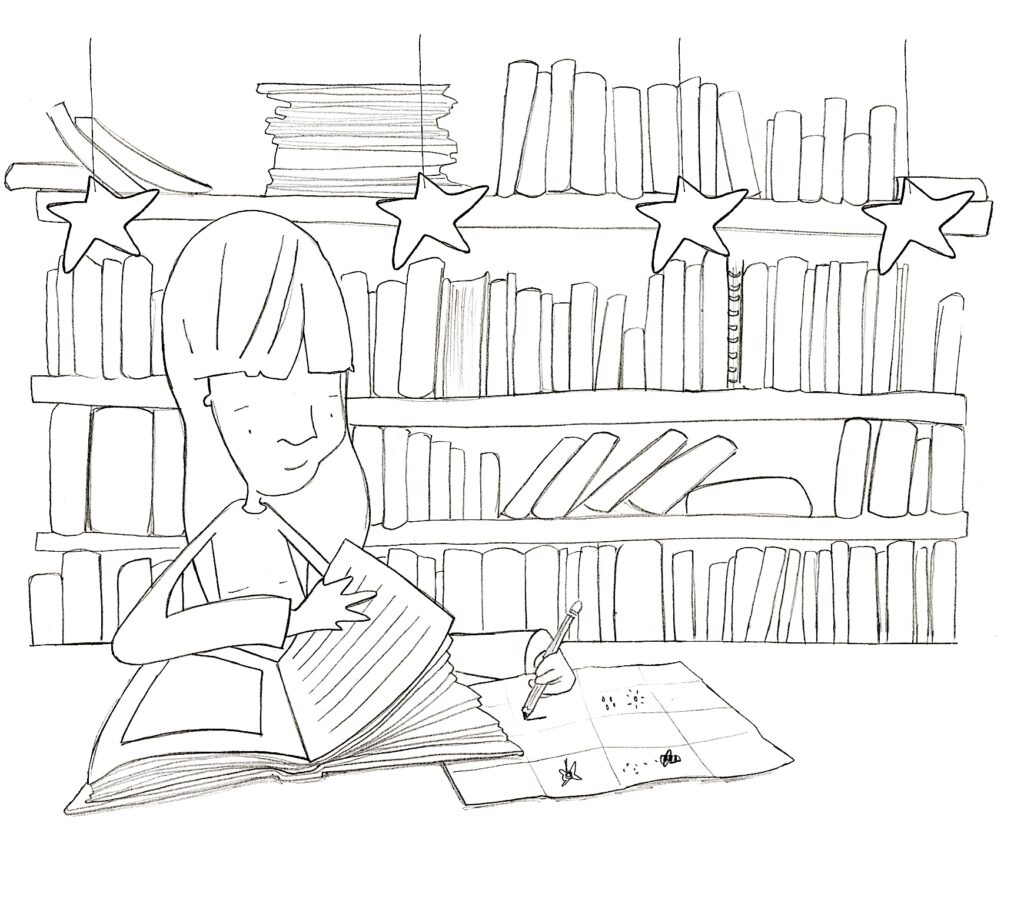
One option is pictures, which form the foundation of my ‘Footnotes’ visual thinking techniques.  For thousands of years, pictorial translation has proven useful as a bridge between languages.  A picture can holistically symbolise a piece of information without needing any sequencing at all.  Unlike spelling or writing sentences, there is no right or wrong picture, so there is no pressure to get it right; each person can draw something completely unique to symbolise their thoughts.  Without the pressure to produce correct sequencing, visual thinkers are far more free to express themselves and are more likely to get out what is in their minds.  The jump for a visual thinker from thoughts to words is a huge one, but from thoughts to pictures is a natural one.  ‘Footnotes’ visual thinking techniques are therefore a form of translation tool for visual thinkers, allowing them to translate thoughts onto paper.

Getting the processed thoughts out of the mind and onto paper is the major hurdle.  Once the learner’s thoughts are down on paper, the process of translating these pictorial thoughts into words is far easier.  My suggestion for visual thinkers is therefore to first think and plan in holistic, pictorial terms, and then translate into linear terms.  Use pictures to ‘say’ what needs to be said, to externally express thoughts, and then translate the pictures later.  I regularly work with students helping them to plan 8,000 word dissertations without requiring any written work at all other than a synopsis.  One picture might represent 30 words, or even 3000.  It will not be readable, but the student knows what it is all about.  An analogy I use is of a memorable day, say somebody’s wedding or birthday.  When you look at photos of the event, you do not just remember the picture, you recall other things that happened at the event, even though those things are not in the photo.  The images are not meant to encapsulate all the information – they are merely the trigger.  I have had students with entire 20,000 word dissertations completely planned in pictures.

For some students, particularly artists, words are an inadequate medium for expressing thoughts – they just don’t ‘say’ what needs to be said.  In most cases, however, a translation of some sort is possible, and in fact I would not want to steal from a student the sense of achievement they get from actually handing in a great wadge of paper.  For some people this is a huge wall they think they can never climb, so my aim is more to alleviate the fear of written assignments, rather than do away with them.  

I often get asked, “What if we allow learners to be so picture-based and image reliant that it actually affects their language and other linear skills that have to be demonstrated in examination-based work?  If we are encouraging picture-based activities might we be leading them away from spending time developing their literary skills?”  Fortunately quite the opposite seems to happen.  What we are teaching them is to use their preferred style of thinking and processing information internally.  By allowing these learners to communicate with themselves more effectively, they then find it easier to communicate externally by speaking or writing.  Ten years ago I struggled to put words in the right order to make a sentence; by using my visual thinking strategies I can now think more clearly by creating images of what I want to say or write, and this has made my external communication much better.  The more efficient use of the right side of my brain seems to service the left side more effectively.

The drawing process may sound laborious and time-consuming.  However, the relief it brings for visual thinkers, and the release of creativity that ensues, more than outweigh the investment of time and effort.  Not only that, but new neural pathways are established that become more and more functional with time.  For some children, these pathways are already established, but are just not exercised in traditional school environments that try to force a learner to think and process in a linear, lexical way.  Just like a muscle, visual thinking can be exercised to make it work better; children that have found it difficult to focus and concentrate in lessons can suddenly find they are able to focus when they discover their preferred, natural thinking style and begin to regularly use it.  Many people find themselves doodling on paper when they are on the phone or concentrating on something else – I encourage adult learners to access this skill and use a similar style of drawing when practicing ‘Footnotes’.  With simple repetition of visual thinking techniques, huge strides can be gained in the development of visual vocabulary over a short period of time.

Eventually, with practice, there is often no longer a need to actually draw images on paper; the mind gets used to connecting input with images and an internal whiteboard takes over from the piece of paper.  

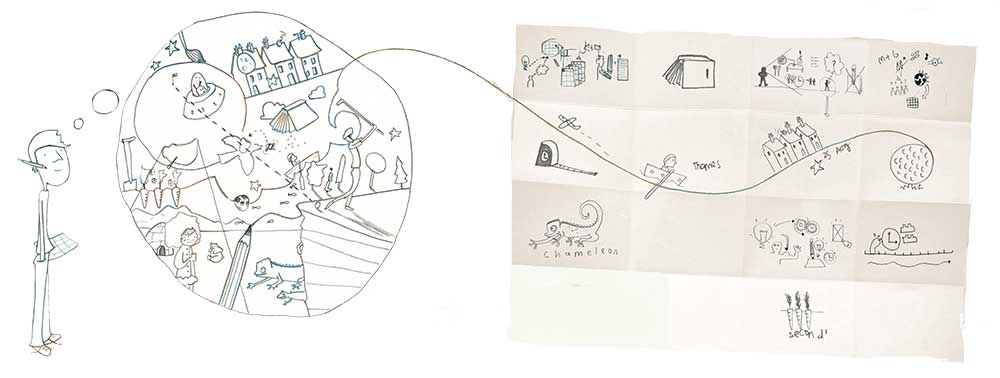
The Footnotes techniques are underpinned by the Footnotes Grid, a tool for arranging and sequencing picture-based information.  The Footnotes Grid is simply a piece of A4 paper folded four or five times and then unfolded.  The folds create a grid with 16 (or 32) equal blocks, and into these, pictures are drawn.  The pictures do not need to be in a linear order – they can be anywhere in the grid.  The idea is to create a sort of map of information, without worrying about the order it needs to go in.  When the whole thing is down on paper, it can then be decided how to link the various pictures to make a sequence.  If necessary, the grid blocks can be ordered, either by numbering them or cutting them up and laying them out in sequence.

When drawing in the grid, the first picture that comes to mind is the one to put down.  It is important not to think logically about it!  Children are good at putting down an image that sounds like something but has nothing to do with the actual piece of information – as long as the image triggers the recall of information it doesn’t matter what it is.  One must trust that the image will do the job and not think about it too much. The pictures do not need to be high quality, so no inherent artistic skill is required; they will not need to mean anything to anyone else.  The quicker they are drawn, the better, because this allows the thinker to move on to the next thought.  Sometimes people who are good at drawing do not like using the grid when note-taking, for instance, because they don’t have time to draw a ‘good’ picture.  They must be encouraged to put this perfectionism aside!  The grid is great for encouraging everyone to draw, even those who are nervous of drawing, because quality is not an issue.  It can be fun!

So how can the grid be used for specific learning tasks?  In the area of language learning, there are several possible applications – here are some examples:

  1. Vocabulary Grid.  A visual learner needs to link an image with a new word to be learnt, rather than a word in their mother tongue.  A visual dictionary can be rapidly built up, full of completely unique images linked to new vocabulary.
  1. Listening Comprehension Grid.  Rather than trying to internally process linear sequences of words in another language, visual notes can be made in the grid squares.  These can then be translated later. 
  1. Reading Comprehension Grid.  A learner would usually look at a word in another language and attempt to translate it directly.  Visual thinkers can find it helpful to summarise text in pictures, before translating this into another language.
  1. Essay planning Grid.  As mentioned above, a whole essay could be summarised in pictures.  The jump from pictures to a new language is easier for a visual thinker than the jump from one language to another.
  1. Translation Grid.  Again, pictures can be used to bridge the gap between two written languages, making it an easier task for visual thinkers.

The Footnotes Grid can also be used as a memory aid.  Visual thinkers can struggle with retaining information in their minds; instead of sequencing lots of things to remember, new thoughts tend to replace previous thoughts, which are then lost.  The Grid is useful for ‘emptying’ the brain of things the thinker is trying to remember; these can be prioritised later.  It would take too long for the visual thinker to think of and write down words for these thoughts, but an image that triggers the memory can be drawn instantaneously.  

Footnotes techniques are designed to slot in alongside existing teaching methods.  Students can use the Grid alongside their textbooks and worksheets, translating the information they contain into words when required.  Each learner will learn how to adapt the techniques to suit their own learning style, using the Grid when they find that it helps.  

In summary, Footnotes visual thinking techniques offer visual and holistic thinkers a way of processing and expressing information that naturally fits their learning and thinking style.  Instead of struggling with sequencing letters, words and sentences in order to communicate, the techniques allow learners to express their thoughts visually, before translating into words when necessary.  This relieves the pressure of having to think in words.  Many visual thinkers speak of pictures being their ‘first language’ and words being their second; Footnotes techniques give these learners tools to express themselves in their first language.  The techniques are simple to use, and often facilitate dramatic learning breakthroughs for students who have consistently struggled with traditional classroom teaching and learning methods.  

In terms of language translation, foreign students who have struggled with cultural and language differences have found that Footnotes techniques have proven to be a useful translation tool, helping to tackle phonetic spelling differences between languages and providing a bridge between differing language structures.

www.oliverwestfootnotes.com
Unlocking the Multilayered Mind of a Designer: A Key to Community Transformation 

Abstract

Modern society is dominated by words, and most of us don’t think twice about it. We train children to think and learn in linear, word-based ways from a very early age, marginalising alternative ways of processing information and those who use them. Yet a vast majority of individuals are to varying degrees visual and multilayered thinkers. This is often only identified when it manifests as a so-called learning difficulty, and is still not understood. In education, enterprise and the third sector, an absence of diverse, inclusive and holistic thinking processes result in a reduction of both quality and depth of impact. When it comes to helping underserved communities this lacking in particularly felt, where low levels of resource and self-worth, and high levels of trauma or neglect result in an even greater need for an alternative way of thinking, processing and communicating. 

The Footnotes Programme has been proven to quickly bring dramatic and lasting breakthroughs to people from many different backgrounds, including those who were previously thought of as beyond the remit of a traditional working solution. It encourages and harnesses the power of picture-based communication, is straightforward to teach, easy to learn and infinitely adaptable to any individual or situation. Footnotes has been taken into multiple humanitarian contexts, most recently with Syrian refugees around the Middle East, and has been embraced by people from many different cultural and social backgrounds — from inhabitants of refugee camps to leaders of International NGOs. Our presence in South Africa is perhaps the strongest outside of the UK. 

We work to share these visual, multilayered thinking tools with those within communities in crisis, to enable individuals to realise their own potential, identify needs, and be a part of the change they seek, both personally and for their wider community.

Keywords: Communication, education, visual-thinking, empowering, drawing

Introduction

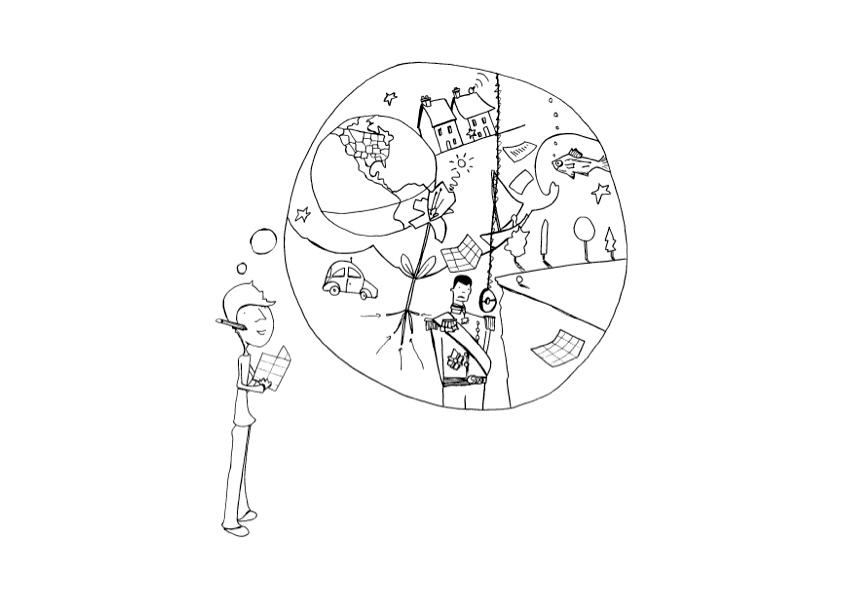
If design is about the conception and evolution of an idea, and the production of plans that could make it a reality, then Footnotes is about extending design to any and every type of idea or thought process. It is a collection of strategies that help individuals to discover and develop their internal thoughts, feelings and ambitions and then communicate these visually, so as to ultimately bring about change or create something new.

This is a generalised statement, because Footnotes really can be applied in a multitude of ways and to many varied situations. It takes design and makes it a first language — steering users away from the limitations of solely word-based communication, towards less linear and more personalised visual and multilayered thinking, planning, communication, and actioning. This can be applied in all sorts of contexts, including education, business, emotional processing, organisation and creativity.

This paper introduces the idea of Footnotes visual multilayered thinking, giving some explanation of the strategies, and why we believe they work, then sharing real examples of how they are used in different international settings, sectors and disciplines. It will focus in particular on the work of the Footnotes Reach project, which takes the approach into various humanitarian settings, including several South African communities, working with those from different cultures, across all ages, including those with disabilities or extreme so-called learning difficulties, and often uniting those from conflicting people groups. It will also examine some of the unique qualities of this innately design-based programme, with an emphasis on how this is helping to change the world for “the other 90%” through a community capacity building approach, collaborating with people to promote and enable sustainable development and self-reliance. The paper concludes that unlocking multilayered minds of designers is a key to community transformation.

Discussion

What is Footnotes?

Footnotes is a set of strategies that facilitates individuals to think and plan in holistic, pictorial terms, using drawing to both capture and unlock thoughts. These can then be translated into many different ways, as the situation demands. It encourages the use of symbolic vocabulary, by-passing a dominant use of words to help individuals realise and express their internal thoughts and ideas, without the pressure to produce correct sequencing. In this way, visual thinkers are far freer to express themselves and are much more likely to externalise their thoughts. Individuals often go on to turn their drawings into sequenced communications, so that they are able to share these thoughts with others. (West, 2007)

These techniques have been used in a wide variety of contexts, and are increasingly adapted to many aspects of community life all over the world. There are applications in mainstream education, special educational needs, enterprise, the public sector, health and healing, reconciliation, community life and humanitarian aid, with many case studies on the impact that these strategies have, particularly in scenarios way beyond the remit of a traditional working solution.

Just one example of Footnotes being used to help those with complex communication and learning needs, within a humanitarian setting, happened whilst training social workers operating in an under-served community in the Middle East. We were taken to meet one of the more challenging cases they were dealing with at the time. On top of the other daily pressures that this particular family faced, five out of their eight children were classed as deaf and dumb, and they had a very minimal amount of communication in place, which did not include sign language. 

Footnotes was seen to very quickly impact those children, just in the brief demonstration workshop that took place, with them finding a “voice” for the first time as they communicated through a drawn visual medium. The excitement from the social workers was highly evident  as there had not been any such progress witnessed in this family before, and these dramatic results came about within the space of 30 minutes. An invitation has been made to offer training across the whole region and we look forward to working with them in an ongoing way, transferring knowledge to local professionals so as to sustain a much needed impact on the whole community.

The techniques we are using are underpinned by the Footnotes Grid, a tool for arranging picture-based information. The grid is simply a piece of A4 paper folded four or five times and then unfolded. The folds create a page with 16 (or 32) equal blocks, and into these pictures are drawn, often prompted by particular questions asked either internally or by another. The pictures do not need to be in a linear format – they can be anywhere in the grid. The idea is to create a sort of map of information. Much like a designer comes up with a blueprint for their product, the end result is a visual communication of the internal visions and, where applicable, a set of instructions to carry them out.

The impact of this becomes particularly apparently when multiple grids work together as a system. This is a unique approach that is unlocking the potential of individuals in much needed ways. Footnotes is particularly distinct because it is transferable across all cultures, languages and social settings. It is a multi-national, multi-lingual and multi-agency strategy that brings people together, in a richer and more holistic way than many linear forms of communication and intervention can. This has been called a radical and innovative way of learning and processing information, yet we believe that it’s simply reconnecting with human beings’ inherent ability to see the bigger picture. 

One stark example of this impact on the culture of learning comes from a community in the Western Cape of South Africa. This is an area where both the social, and literal, landscapes are comprised of polar opposite conditions. The community at the south end of the main street are home and landowners, whose schools have irrigated playing fields, whilst half a mile up the road the school in the north end is set in arid stony grounds with very limited facilities. We have had the opportunity to share Footnotes in that school several times over the last decade. This so called primary school has students whose appearance suggests are closer to their mid-teens. Academic output was very hampered and any attempts at measuring their ability showed dire results — because many could not read or write, exam papers produced answers of carefully formed letters that had no meaning. The shocking thing is that this is not an isolated case. It seemed nobody believed these students to be capable of anything and all that was done with them added to this theory. The approach of the school, taking their lead from outcome-based teaching methods, was to remove their woodworking and technology workshop to create space for a library — to house a handful of books that many could not read. In the words of one teacher Linda, “We’ve seen that the teaching methods imposed from either the UK or from the states just doesn’t [sic] work.” (Fodor, 2012)

We gave the challenge that the children were far more capable than any believed them to be, and set about getting them to draw grids of their hopes and dreams. Teachers were shocked into silence by the creative ability Footnotes unlocked in the students. Young people who had persistently failed to interact, and never demonstrated any kind of ability even when asked to draw, now filled pages with image after image. Linda also told us that “children that have never spoken English to me were suddenly willing to describe their pictures in English” (Fodor, 2012), which is a significant discovery to make. It seemed no-one knew what the children could actually do, or what was going on under the surface. They had never been asked in a way they could relate to. In fact many of these young people were for the first time evidencing complex thought patterns and high aspirations, such as to be architects or police officers, all as a result of using Footnotes to capture and release their thoughts.

Of course the education system still demands measurability, which most likely means demonstrating an ability to answer exam papers, and Footnotes also offers many strategies to help develop these skills, with educational grids for writing, reading, spelling, essay planning and many more. Yet just to begin, connecting and communicating with the young people was the biggest hurdle they needed to get over and this shift in learning style, embracing a more visual culture, opened a door that was previously not known to exist; drawing in the grids provided this much needed opportunity.

Linda’s observation was that “even though your system comes from the UK we could use it as a really African system of teaching our children. And that’s something that we need, a system that works for South Africa.” (Fodor, 2012) We see design here breaking through as an international language, and we see Footnotes as a global system being totally adapted to a very local setting. 

How Footnotes helps

The idea of Footnotes developed out of my own experiences, as both an artist and a schools worker. Classed as a chronic dyslexic, it took many years for me to understand that my struggles in a limiting linear-dominant education system stemmed from my strong visual multilayered thinking tendencies. Setting out as a landscape artist I realised that my very best work was produced whilst under pressure, be it from time or the elements. The lack of control that I had over my situation freed me up to create. When learning to draw, a student is taught to look more at the subject than their drawing, because memory will create a logical response that can be very different to the reality. This need to override the “false logic” of the analytical brain is the same thing that I was experiencing, and other artists through the ages have had similar revelations. Turner is said to have strapped himself to a ship’s mast to experience a storm with all his senses (Butlin & Joll, 1984), as it simply wasn’t enough for him to commit the scene to logical memory, with all the filters and corrections that a subconscious mind can, sometimes unhelpfully, make. 

Aware that I was not the only one who could benefit from this realisation, I still had no way in which to harness it — until one day, when working as an artist in resident in a primary school, there were three disruptive boys at the back of a classroom. I decided to get them to draw what they “thought and heard” and — partially so that I could throw it across the classroom easily — folded a piece of paper four times and sent it their way. At the end of the day, the teacher commented on how well the children had behaved and interacted. And so it began, testing and adapting this process for other students, and discovering time and again that not only did it work in the moment but that for some young people it actually changed the way they interacted all of the time.

I believe that this approach succeeds by putting less emphasis on traditionally established ways of thinking. By using a non-linear, visual approach to thinking and communication, the more creative aspects of the brain are unlocked. The extra activity engages the brain in ‘dual processing’: a state of “busyness” that stops one from being over analytical and, ironically, helps those who are easily distracted to focus. This approach — which went on to develop and later become known as ‘Footnotes’ — seemed to provide a way for people to move beyond the limitations that they imposed on themselves, or have had imposed on them, “getting out of their own way” to open new doors in thinking and creating.

This is not something that is only useful to a handful of people, or to those in a troubled setting. I believe that the majority of people — designers included — have been affected by a system based on linear structure that can restrict creativity, vision and output. Footnotes gives both permission, and a tool, to unbox thinking and expand horizons. It captures something of the artistic mind and brings it to a world that has much need for it, in both the ever advancing “developed” regions and with those who have not had the same opportunities. 

In particular, this style of communication offers an instant language to anyone in any situation. Because visual comprehension does not require a high level of acquired skill, it enables almost anybody to engage immediately, no matter their level of training or linguistic development. This produces a levelling effect that is non-hierarchical in its nature, counting the contribution of all people as equal, and awarding the same value to any image. That makes Footnotes a programme that is intergenerational and cross-cultural, bridging the gaps between those with particular kinds of learning experiences or expertise. For example, a child has the same ability to read an image as an adult does; they might not interpret the same thing but that doesn’t mean to say it’s not just as important or powerful. Worth is no longer decided on the basis of established rules or modes of expression, and this qualifies those who previously lacked power to contribute in meaningful ways.

Conclusion

Footnotes takes this equalising quality to the 90% whose lives have not been improved by design, to give them a design-based processing and communication strategy that can be used whether or not they’ve ever had a pencil in their hand before, or a voice in the dialogue. It is a tool that can be used to improve life for themselves. This empowerment is crucial to the way that Footnotes Reach works, and is described by the UK charity commission as “ community capacity building” (Charity Commission, 2000). This means that it works with individuals in order to help them better identify and meet their own needs, as well as to participate more fully in society, thus effecting sustainable change within their community. In South Africa, where 50% of young people are unemployed (Yueh, 2014) and only a third of those newly entitled are registered to vote (BBC News, 2014), what’s needed is a change at the very heart of how individuals, and communities, engage with themselves and each other.

Einstein is famously attributed to have said, “If I can’t picture it, I can’t understand it”, and perhaps one can infer from this that if you can picture it, you can understand it. That has certainly been the experience of Footnotes. And with that understanding comes the hope, and the vision, that if we can help people to visualise both their situation and their solution then they will realise for themselves the ability they’ve got to make an impact on their lives and their communities. This hope, together with the practical way that Footnotes brings people from very disparate backgrounds together, is the reason we believe that unlocking multilayered designer minds is an important key to community transformation; as much for those wishing to help as for those in crisis. 

Reference list

BBC News. South Africa in post-Nelson Mandela elections. 2014. Retrieved 7th May 2014, from BBC News: http://www.bbc.co.uk/news/world-africa-27303636. [Sl].

Brown, D.B. J.M.W. Turner: Sketchbooks, Drawings and Watercolours. 2012. Retrieved 17th June 2014, from Tate: https://www.tate.org.uk/art/research-publications/jmw-turner/joseph-mallord-william-turner-1775-1851-r1141041. [Sl].

Butlin, M. & Joll, E. 1984. The Paintings of J.M.W. Turner, revised ed. New Haven & London: Yale University Press.

Charity Commission. The Promotion of Community Capacity Building. 2000. Retrieved 23rd April 2014, from Charity Commission: http://www.charitycommission.gov.uk/media/95193/rr5.pdf. [Sl].

Fodor, L. 2012.  Interview with the author. December 2012, [Digital recording in possession of author]. Prince Albert.

West, O. 2007. In Search of Words. Truro: Footnotes Publishing.

Yueh, L. The jobs challenge facing South Africa. 2014. Retrieved 9th May 2014, from BBC News: http://www.bbc.co.uk/news/business-27337520. [Sl].

Hemispheres, Dyslexia, ADHD & the Visual Learning Revolution – Thinking with Footnotes

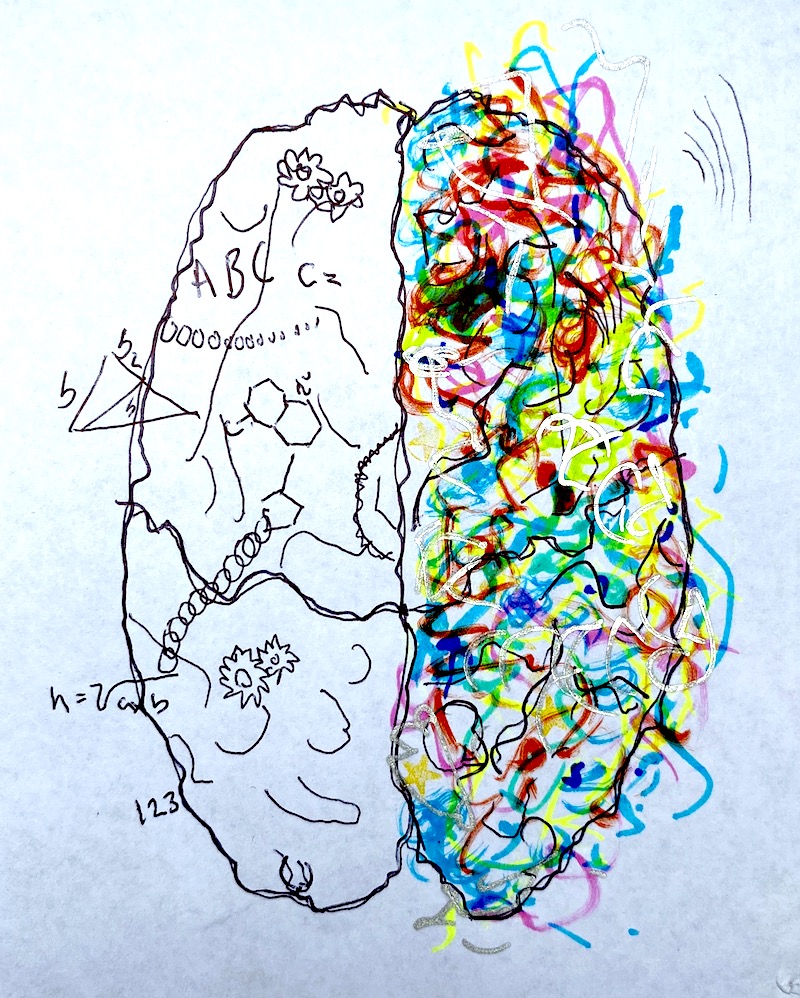
There are two brain hemispheres, left and right. Joined by the corpus callosum (which keeps these two symmetrical hemispheres apart, whilst also providing a path for communication). The two hemispheres interact and work together. Each perceives, and thus creates, a different kind of world!.

Iain McGilchrist explores the philosophical and psychological implications of what is known as hemispheric specialisation. He describes the way that culture and society are impacted by the unique way each hemisphere ‘attends’ to the world.

The left hemisphere is concerned with the known, with no appreciation for ambivalence – it thinks that it knows everything. It generates a mechanistic understanding of what it is to be human. It’s a world of ‘either/or’, reason, procedure, and logic.

The left hemisphere pays precise attention and reduces the world to ‘things’ and parts. It sees everything as static, separate, distinct, and disembodied – often abstracting information from its wider context.

The left hemisphere’s world is inanimate and mechanistic; it is not emotionally orientated. It pays focused attention with a view to mastery. This kind of attention serves us well in an emergency!

The right hemisphere is concerned with what we don’t know; it’s a hemisphere comfortable with mystery and paradox, seeing the broad picture. It is aware that it doesn’t know everything.

The right hemisphere’s world is creative, with high levels of emotional and social intelligence present. In perceiving the ‘whole’, the right hemisphere looks for gaps in the structure. The gaps are where the light gets in, as it were!

The right hemisphere generates a holistic, experiential understanding of what it means to be a human.

The right hemisphere’s world is one of ‘both/and’. It’s a world of coherence, connectedness, fluidity, flow and change. It’s a relational, animate, and embodied world. Reality is known within the context of presence and gestalt.

The two hemispheres of the brain are meant to work together. We need polarity, balance, and integration. We need the part AND the whole.

Within the context of the connectedness of our inner and outer worlds, McGilchrist suggests the left hemisphere has become dominant within modern Western Society.

In any given situation, our brains are offered two perceptions by both the left and the right hemisphere. Our challenge is to become aware of both, and, as a result, to make balanced decisions.

What is known as the ‘Industrial Revolution’ took place between 1750 and 1900.

Arguably, a mechanistic and reductionist way of seeing initiated and established this period of great technological advancement. This great shift likely played a key role in the left brain dominance we are experiencing at a societal level.

McGilchrist argues that nothing is isolated – not even an organelle in a cell; not even a proton, neutron, or electron. Even ‘parts’ are part of a whole, which is what he argues is the ‘matter with things’. 

Instead, he claims, we are always in process and in connection.

We are part of a ‘greater’ whole and, therefore, reduction to parts is merely an illusion.

We need to see the whole, and to become aware of what we don’t know (yet)!

It has been said that we live in a world lacking in meaning! We can call on the left hemisphere to bring some order, but we might need some help from the right hemisphere to bring some balance and harmony back into society!

More people are depressed and disconnected from their bodies, others, and ‘nature’ than ever before!

What would it look like to reintroduce awe, wonder and mystery into society?

What would it look like to reconnect with our bodies, with each other?

What would it look like to explore ways of knowing that encompassed holistic, intuitive, and imaginative thinking?

A different way of learning and knowing...

“True science has more questions than answers, and it does not have any answers that can’t be questioned.”

Albert einstein

So where does dyslexia and ADHD come into the equation?

Pioneering scientist, Albert Einstein often saw his discoveries intuitively and in his ‘mind’s eye’. Einstein was a known dyslexic and it is said that he often had to ‘work backwards’ to show how he came up with his discoveries!

Dyslexia is a title for a neurological divergency that (with the very limited testing available) is already estimated to affect at least 10% of the population worldwide. However, it’s very likely to be much higher a percentage than the current estimate.

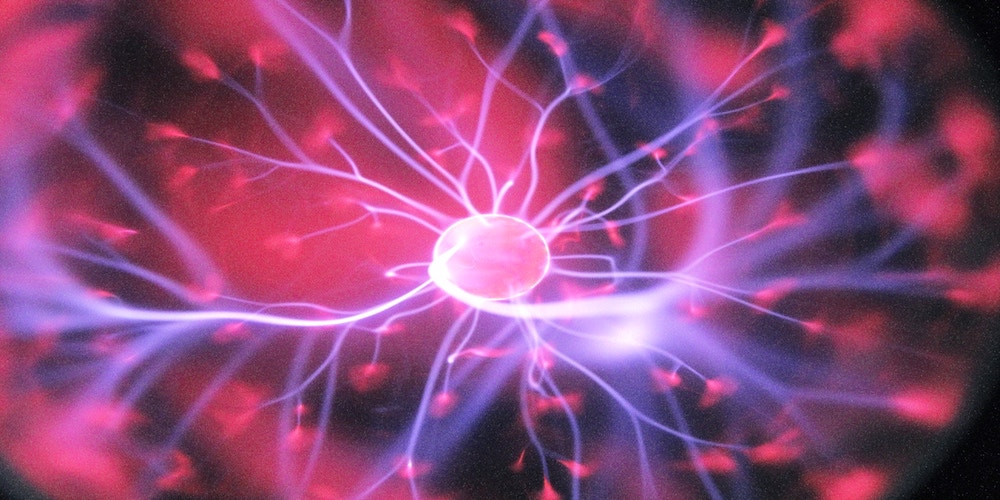
Dyslexia is associated with a mildly impaired development of ‘magnocellular cells’ (also known as magnocells and M-cells) in the brain (see the work of Professor John Stein for more information).

Whereas some people often find linear sequencing, time-keeping, and subjects like reading, writing and maths easier, those with dyslexia might find creative subjects easier, as they see laterally, holistically, and can spot patterns.

In dyslexics and those showing ADHD tendencies, the left brain is said to remain more proficient at visual-spatial processing – even in light of the kind of ‘left dominant’ society previously mentioned.

Therefore, the dyslexi/ADHD brain works in a more balanced way, as they exhibit stronger right-brained visual thinking than for example a non-dyslexic brain. 

Stein points out that this way of seeing is more aligned to nature. Society needs dyslexics and right-brained thinkers; they often excel at subjects and skills that others don’t!

Writer, Thomas West points out that so many incredible entrepreneurs and pioneers across history have been dyslexic.

So many amazing and important and discoveries have happened as a result of this unique way of seeing!

A few examples…

Mandelbrot discovered fractal mathematics (essential for mobile phone technology); Watson and Crick were the first to envision the structure of DNA; Einstein was inspired with the ‘theory of relativity’; and Faraday was a pioneering scientist at the world-famous Royal Institute. And let’s not forget world-changing business leaders like Richard Branson.

Dyslexics and often those with ADHD often seen to be gifted with being able to see things ‘out of the box’, which can often be coupled with a greater level of fortitude, developed through overcoming the struggles associated with not thriving in left-dominant modes of education.

Creative leaning pioneer, Ken Robinson argues that we have outgrown the post-war education system. Remember the days when the ’11+’ exam decided whether students were going to attend either ‘technical’ or ‘grammar’ school? Whilst the ’11+’ has been scrapped, Robinson is highly critical of modern mass education that still prepares students for the workforce, and for the kind of standardised, mechanised society that prevails today.

We’ve divided learning up. We’ve reduced it to subjects, which are separated by ringing bells!

There is an over-focus on testing and curriculums… there’s a fear of being wrong!

This sounds a lot like the world of the left brain!

Left-brain dominant learning can be said to perpetuate some of the problems we face today. A creative approach to education would equate to a greater level of hemispheric balance, which would have society-wide and world-wide impacts.

The world is facing new challenges – an ecological crisis, a supposed overpopulation problem, and a movement towards an automated workspace. The survival of humanity depends new solutions for new problems, argues Robinson!

We need big-picture, creative solutions!

Today’s children hold the key to so many of these creative solutions, they just need to be unlocked!

We need to create a new system, one where creativity thrives, and one where every child flourishes.

We need a move away from left-brain dominance and a move towards creative education.

This isn’t just for some students, but for all students.

It’s just not good enough that some students fall behind because their uniqueness isn’t cultivated.

So where does Footnotes come into all of this?

At Footnotes, we help to support and cultivate a visual and multi-layered approach to thinking and learning. We offer a range of techniques to help all kinds of minds.

When working with people who have a dominant right hemisphere response, Footnotes plays a vital role in helping individuals to capture the important parts of the ‘big picture’.

Footnotes helps people to find realistic ways of actioning the most important subjects detailed on their ‘Grids’. 

Footnotes also helps individuals who recognise that they are left brain dominant, or who recognise that the left hemisphere plays a major part of their decision-making throughout the day.

As a result of using Footnotes, individuals are able to move themselves into new ways of processing, and potentially move away from the pitfalls of left hemisphere thinking. 

The act of drawing and thinking creatively outside of a linear requirement automatically challenges the left hemisphere dominance, giving opportunity for the right hemisphere to play its role. 

Footnotes activities directly help an individual to redress the balance of the left and the right hemispheres when problem-solving, and when making general decisions in life.

With the process of mapping thoughts out with the Footnotes Grids, individuals can directly observe thinking processes, and notice how one choice is possibly informed by either the left or the right hemisphere, or both!

A reflexive approach gives rise to opportunities for an individual to change the way they respond in a given situation.

The various Footnotes strategies available promote a multi-layered approach to learning and living life. This creative process naturally helps individuals to lead their own inquiry and to be less reliant on being led or taught. Instead, the Grid-ing process helps individuals to be intuitively aware of what they should be doing next.

Footnotes offers personalised creative thinking tools that utilise both hemispheres and encourage imagination, intuition, and therefore healthy levels of individuality – even within structured curriculum situations.

As a result of engaging with the Footnotes Programme, individuals often say that they feel more intelligent due to the awareness of being able to process thoughts and information more quickly and effectively. They often let us know that this helps them to feel more confident and more capable in their day-to-day decision making.

Many have reported looking back through their life-choices, remembering how Footnotes empowered them to be bold in pursuing their dreams and in making formative decisions.

We’ve observed huge changes in Footnotes users’ time-management abilities, and also a significant improvement in effective social interaction – due, in part, to individuals feeling more informed by their intuition and multi-sensory abilities. These huge and often immediate shifts become apparent once an individual has harnessed their natural visual thinking capabilities that emerge and are honed through ‘Grid-ing’. 

In the absence of these sorts of realisations that are uncovered through a journey of self-discovery, we witness that dyslexics become overly reliant on being lead by others (rather than leading their own learning). This dynamic is exacerbated by the large amount of testing carried out within the current education system. 

“The education system has mined our minds in the way that we strip-mine the Earth for a particular commodity, and for the future it won’t serve us.”

Ken Robinson

We need change.

We need to recreate an education system that encompasses all of the wonderfully unique ways of seeing and learning.

We need to move towards a re-balanced society; we need to envision and co-create a world of balanced minds and collectives.

The future starts now.  Happy Grid-ing!

  • Courses
  • About
  • My Account
  • FAQs
  • Contact
  • Facebook
  • YouTube
  • Twitter
  • Instagram

© Copyright · Footnotes Visual Multi-layered Thinking Grid Training • Terms & Privacy

WordPress web design Cornwall