
Language Learning & Dyslexia Symposium – School of Oriental & African Studies, London
As globalisation marches on, overcoming language barriers has become increasingly important, and the requirement for global translation is rapidly growing. Linear, lexical information transmission is the norm, and most of us don’t think twice about it. But the logic behind the structure of language differs dramatically from language to language, and could often be better understood in holistic rather than linear terms; direct translation from words of one language to words of another is often counter-intuitive and ‘illogical’.
In addition, we train our children to think and learn in words from a very early age, marginalising alternative ways of processing information. We know that children learn through play, but we hope that they learn to read and write sooner rather than later. We assume that traditional words-based teaching and training methods are right and proper, and that people who don’t get on with them lack a degree of intelligence. Our schools and universities are consequently squeezing non-linear thinkers out to the margins, quashing creativity and variety in a bid to produce students who will pass exams. Many of these marginalised learners are branded with a ‘learning difficulty’ label, simply because they think and learn in a way that is incongruous with traditional classroom teaching. In truth their difficulty often lies with the teaching methods they are subjected to, rather than their intellects. Even if a visual thinker is identified, teachers and parents can struggle to know how to encourage this ‘different’ way of thinking, often because they simply don’t understand it.
Learners who think in a holistic, visual way often find written language difficult. Most of the issues that visual thinkers and dyslexic learners struggle with stem from having to read or write sentences in which letters, words and information must be sequenced. Professor John Stein of Oxford University has been researching the physiological reasons for dyslexic reading behaviour. The following is quoted from a seminar he gave (“Visual Dyslexia: Force of Artistic Talent”) at the 2003 Arts & Visual Thinking Conference in Falmouth:
“Reading requires precise sequencing of letters and word sounds, and in fact there is no other normal activity of human beings that requires such precise linear sequencing. But dyslexics are bad at this kind of sequencing… because they inherit a vulnerability of a particular kind of nerve cell in the brain called a Magna cell… Magna cells play a very important part in reading in particular, because they control how the eyes move during reading. How the eyes move during reading determines how you sequence things – how you sequence small objects such as letters.”
He has found that due to a developmental deficiency in Magna cell formation in the brain, the eyes of dyslexics do not move from left to right in tiny movements like a ‘normal’ reader’s eyes. They tend to make larger eye movements, and consequently find it very difficult to sequence letters and words. There are several ways to improve reading ability; I have found that dyslexics find it easier to read in columns – when working with children I limit the number of words to five per line. Coloured lenses have proven to be very effective for some dyslexics, and Professor Stein has shown that this is because Magna cells are particularly sensitive to yellow and blue light, and so by wearing coloured lenses the Magna cellular system can be boosted to improve reading.
But the pressure of having to sequence information linearly can make a dyslexic or visual thinker freeze, and can sometimes stop them from reading, saying or writing anything at all. Holistic, visual thinkers will sit down at the computer to write an essay, and they might get out a few sentences before they stop because it doesn’t sound right, or they haven’t used the correct grammar, or the spelling needs correcting. But by the time they’ve gone back over those sentences to try and get them right they have lost about five other thoughts that they had when they were initially inspired to write. This is not only unproductive but extremely demoralising.
And it is a pattern that is all too familiar for visual learners. Whatever the information they are attempting to process (from filling in forms to language learning), sequencing is often their greatest stumbling block. Visual thinkers see holistically, they see all the information at once, rather than in a linear order. Written words are therefore like a foreign language to them, even in their mother tongue.
So is there a way in which visual thinkers can learn more easily? A way in which they can process information and communicate holistically? Is there a way to break down language barriers more efficiently?
One option is pictures, which form the foundation of my ‘Footnotes’ visual thinking techniques. For thousands of years, pictorial translation has proven useful as a bridge between languages. A picture can holistically symbolise a piece of information without needing any sequencing at all. Unlike spelling or writing sentences, there is no right or wrong picture, so there is no pressure to get it right; each person can draw something completely unique to symbolise their thoughts. Without the pressure to produce correct sequencing, visual thinkers are far more free to express themselves and are more likely to get out what is in their minds. The jump for a visual thinker from thoughts to words is a huge one, but from thoughts to pictures is a natural one. ‘Footnotes’ visual thinking techniques are therefore a form of translation tool for visual thinkers, allowing them to translate thoughts onto paper.
Getting the processed thoughts out of the mind and onto paper is the major hurdle. Once the learner’s thoughts are down on paper, the process of translating these pictorial thoughts into words is far easier. My suggestion for visual thinkers is therefore to first think and plan in holistic, pictorial terms, and then translate into linear terms. Use pictures to ‘say’ what needs to be said, to externally express thoughts, and then translate the pictures later. I regularly work with students helping them to plan 8,000 word dissertations without requiring any written work at all other than a synopsis. One picture might represent 30 words, or even 3000. It will not be readable, but the student knows what it is all about. An analogy I use is of a memorable day, say somebody’s wedding or birthday. When you look at photos of the event, you do not just remember the picture, you recall other things that happened at the event, even though those things are not in the photo. The images are not meant to encapsulate all the information – they are merely the trigger. I have had students with entire 20,000 word dissertations completely planned in pictures.
For some students, particularly artists, words are an inadequate medium for expressing thoughts – they just don’t ‘say’ what needs to be said. In most cases, however, a translation of some sort is possible, and in fact I would not want to steal from a student the sense of achievement they get from actually handing in a great wadge of paper. For some people this is a huge wall they think they can never climb, so my aim is more to alleviate the fear of written assignments, rather than do away with them.
I often get asked, “What if we allow learners to be so picture-based and image reliant that it actually affects their language and other linear skills that have to be demonstrated in examination-based work? If we are encouraging picture-based activities might we be leading them away from spending time developing their literary skills?” Fortunately quite the opposite seems to happen. What we are teaching them is to use their preferred style of thinking and processing information internally. By allowing these learners to communicate with themselves more effectively, they then find it easier to communicate externally by speaking or writing. Ten years ago I struggled to put words in the right order to make a sentence; by using my visual thinking strategies I can now think more clearly by creating images of what I want to say or write, and this has made my external communication much better. The more efficient use of the right side of my brain seems to service the left side more effectively.
The drawing process may sound laborious and time-consuming. However, the relief it brings for visual thinkers, and the release of creativity that ensues, more than outweigh the investment of time and effort. Not only that, but new neural pathways are established that become more and more functional with time. For some children, these pathways are already established, but are just not exercised in traditional school environments that try to force a learner to think and process in a linear, lexical way. Just like a muscle, visual thinking can be exercised to make it work better; children that have found it difficult to focus and concentrate in lessons can suddenly find they are able to focus when they discover their preferred, natural thinking style and begin to regularly use it. Many people find themselves doodling on paper when they are on the phone or concentrating on something else – I encourage adult learners to access this skill and use a similar style of drawing when practicing ‘Footnotes’. With simple repetition of visual thinking techniques, huge strides can be gained in the development of visual vocabulary over a short period of time.
Eventually, with practice, there is often no longer a need to actually draw images on paper; the mind gets used to connecting input with images and an internal whiteboard takes over from the piece of paper.
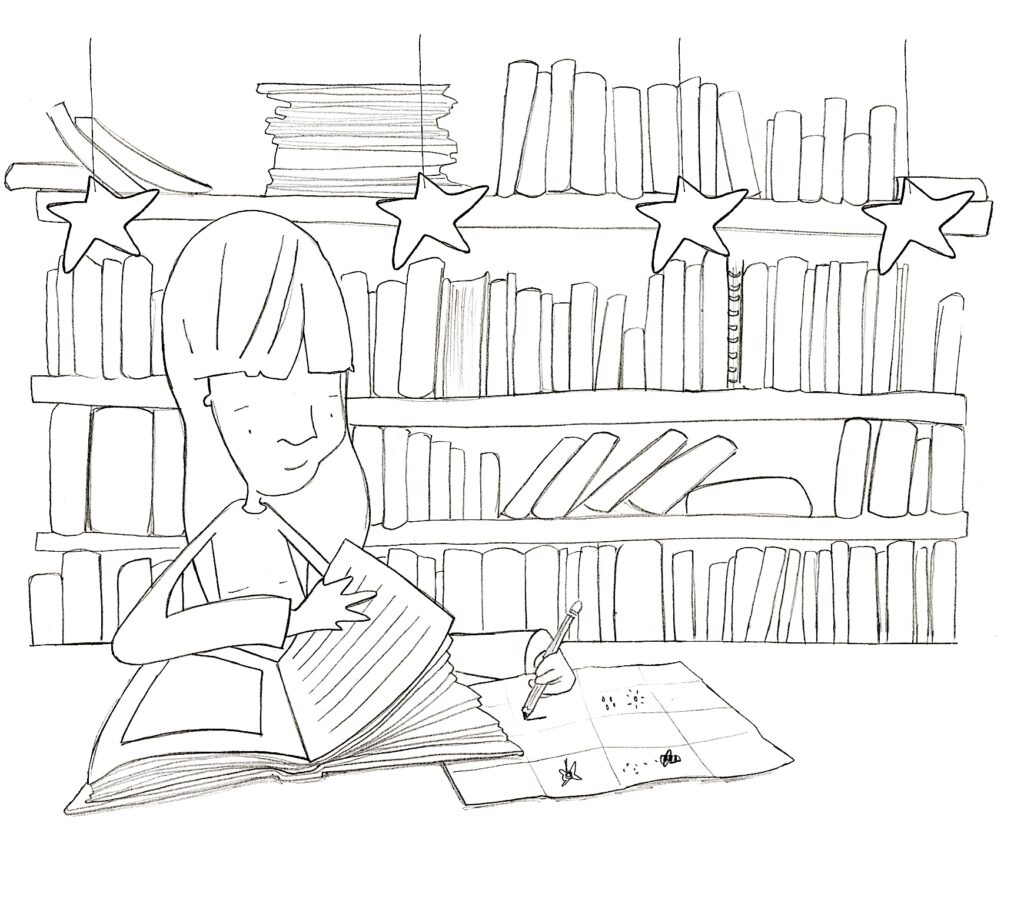
The Footnotes techniques are underpinned by the Footnotes Grid, a tool for arranging and sequencing picture-based information. The Footnotes Grid is simply a piece of A4 paper folded four or five times and then unfolded. The folds create a grid with 16 (or 32) equal blocks, and into these, pictures are drawn. The pictures do not need to be in a linear order – they can be anywhere in the grid. The idea is to create a sort of map of information, without worrying about the order it needs to go in. When the whole thing is down on paper, it can then be decided how to link the various pictures to make a sequence. If necessary, the grid blocks can be ordered, either by numbering them or cutting them up and laying them out in sequence.
When drawing in the grid, the first picture that comes to mind is the one to put down. It is important not to think logically about it! Children are good at putting down an image that sounds like something but has nothing to do with the actual piece of information – as long as the image triggers the recall of information it doesn’t matter what it is. One must trust that the image will do the job and not think about it too much. The pictures do not need to be high quality, so no inherent artistic skill is required; they will not need to mean anything to anyone else. The quicker they are drawn, the better, because this allows the thinker to move on to the next thought. Sometimes people who are good at drawing do not like using the grid when note-taking, for instance, because they don’t have time to draw a ‘good’ picture. They must be encouraged to put this perfectionism aside! The grid is great for encouraging everyone to draw, even those who are nervous of drawing, because quality is not an issue. It can be fun!
So how can the grid be used for specific learning tasks? In the area of language learning, there are several possible applications – here are some examples:
- Vocabulary Grid. A visual learner needs to link an image with a new word to be learnt, rather than a word in their mother tongue. A visual dictionary can be rapidly built up, full of completely unique images linked to new vocabulary.
- Listening Comprehension Grid. Rather than trying to internally process linear sequences of words in another language, visual notes can be made in the grid squares. These can then be translated later.
- Reading Comprehension Grid. A learner would usually look at a word in another language and attempt to translate it directly. Visual thinkers can find it helpful to summarise text in pictures, before translating this into another language.
- Essay planning Grid. As mentioned above, a whole essay could be summarised in pictures. The jump from pictures to a new language is easier for a visual thinker than the jump from one language to another.
- Translation Grid. Again, pictures can be used to bridge the gap between two written languages, making it an easier task for visual thinkers.
The Footnotes Grid can also be used as a memory aid. Visual thinkers can struggle with retaining information in their minds; instead of sequencing lots of things to remember, new thoughts tend to replace previous thoughts, which are then lost. The Grid is useful for ‘emptying’ the brain of things the thinker is trying to remember; these can be prioritised later. It would take too long for the visual thinker to think of and write down words for these thoughts, but an image that triggers the memory can be drawn instantaneously.
Footnotes techniques are designed to slot in alongside existing teaching methods. Students can use the Grid alongside their textbooks and worksheets, translating the information they contain into words when required. Each learner will learn how to adapt the techniques to suit their own learning style, using the Grid when they find that it helps.
In summary, Footnotes visual thinking techniques offer visual and holistic thinkers a way of processing and expressing information that naturally fits their learning and thinking style. Instead of struggling with sequencing letters, words and sentences in order to communicate, the techniques allow learners to express their thoughts visually, before translating into words when necessary. This relieves the pressure of having to think in words. Many visual thinkers speak of pictures being their ‘first language’ and words being their second; Footnotes techniques give these learners tools to express themselves in their first language. The techniques are simple to use, and often facilitate dramatic learning breakthroughs for students who have consistently struggled with traditional classroom teaching and learning methods.
In terms of language translation, foreign students who have struggled with cultural and language differences have found that Footnotes techniques have proven to be a useful translation tool, helping to tackle phonetic spelling differences between languages and providing a bridge between differing language structures.
www.oliverwestfootnotes.com